
New Study Finds America’s Commercial Buildings Are Big Business, Generating Nearly $610 Billion in E
The Building Owners and Managers Association (BOMA) International today released its 2026 Market Study: The Economic Impact of U.S. Commercial Real Estate, finding that the operation and maintenance of office, retail and industrial buildings across BOMA’s 79 U.S. markets generate $609.9 billion in annual economic output and supports 3.9 million jobs.
The study found that $274.9 billion in annual building operating expenditures contributes $344.4 billion to U.S. GDP and generates $219.4 billion in personal earnings. For every $1 spent on building operations, $2.22 in total economic output is generated through direct, indirect and induced economic activity.
Spanning 79 U.S. markets and 35.4 billion square feet of commercial real estate, the study represents the most comprehensive analysis of its kind examining the economic impact of commercial building operations in the United States. Conducted by BOMA every three to four years, the research provides a recurring benchmark for measuring the industry’s economic impact and trends across the commercial real estate landscape.
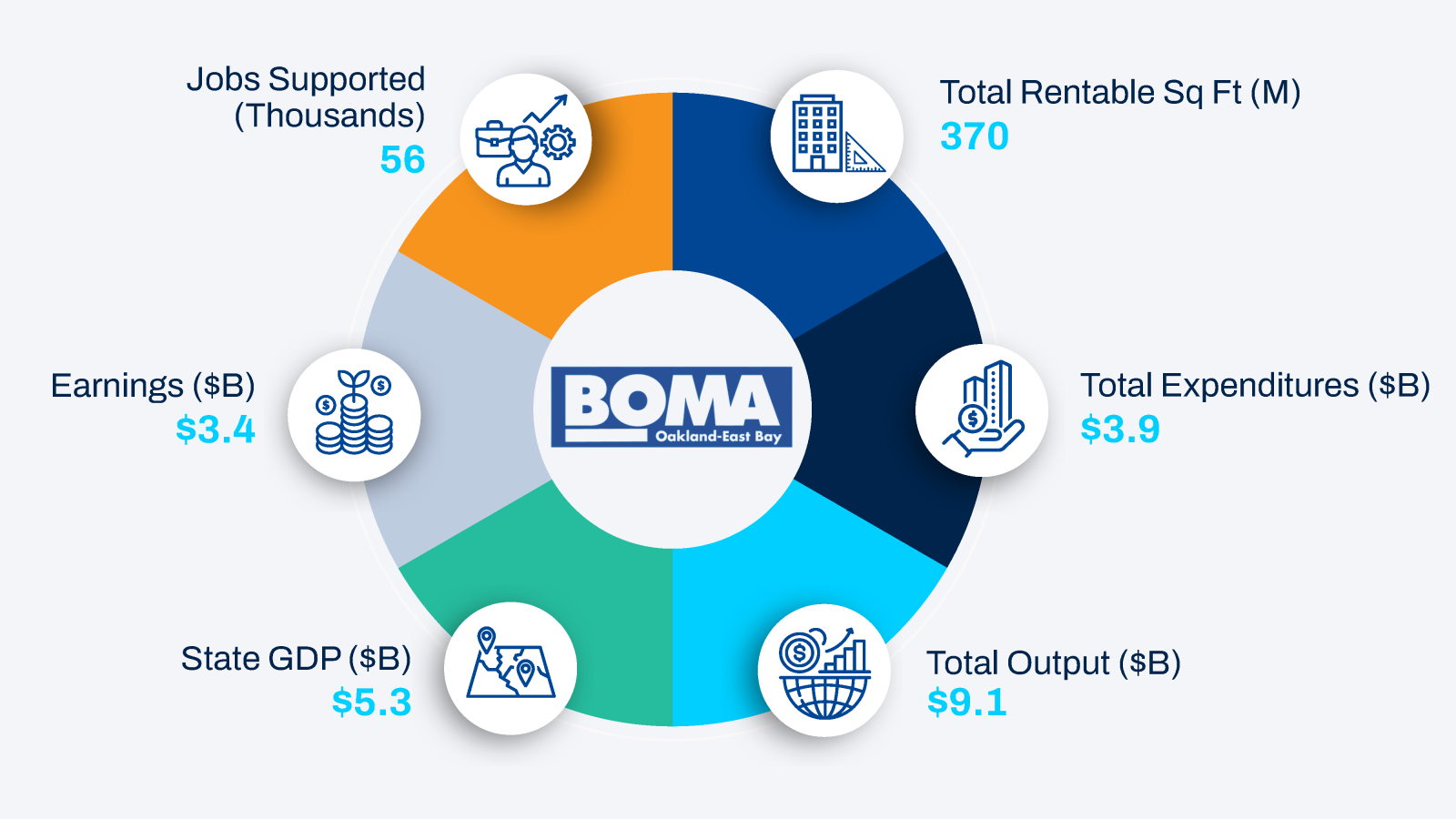
BOMA Oakland/East Bay alone generates approximately $9.1 billion in total economic output from commercial building operations in Alameda and Contra Costa Counties. Additional findings include:
- 56,000 jobs supported
- $5.3 billion contributed to California GDP
- $3.4 billion generated in personal earnings
- 370 million square feet of commercial property represented
“Commercial real estate is a powerful economic engine for the East Bay,” said Julie Taylor, CAE, AAIP, Executive Director, BOMA Oakland/East Bay. “Supporting 49,000 jobs and generating more than $8.1 billion in economic activity, our industry plays an essential role in the economic vitality of the communities we serve.”
California’s Commercial Real Estate properties owned and managed by the eight BOMA locals and their members are a significant source of economic activity. Their total impact on the state is reflected in these figures:
- 537,500 jobs supported
- $50.9 billion contributed to California GDP
- $33.1 billion generated in personal earnings
- 4.1 billion square feet of commercial property represented
Commercial Buildings in a Changing Real Estate Landscape
In addition to measuring the economic impact of operating and maintaining commercial buildings, the study examines construction trends across the office, retail and industrial sectors, providing a broader look at how the U.S. commercial real estate landscape is evolving.
One notable shift is the rapid growth of data center development. Federal construction statistics classify data centers as private office construction, meaning their rapid growth is increasingly shaping overall office construction figures. In 2025, data centers accounted for approximately $41.2 billion, or nearly 46%, of the more than $90 billion in private office construction nationally, compared with less than 5% a decade earlier. Traditional office construction excluding data centers totaled approximately $48.4 billion in 2025.
Industrial construction also remains at historically high levels. Warehouse and manufacturing construction totaled approximately $274.2 billion in 2025. While down 7.9% from the previous year, investment remained more than twice its 2020 level and represented the third-highest annual total on record. Retail construction totaled approximately $47.1 billion in 2025, with activity increasing during the first three months of 2026. In addition, the U.S. life sciences real estate market is normalizing following several years of rapid expansion.
Economic Impact Across the Country
The economic impact of building operations is not limited to the country’s largest commercial real estate markets. BOMA’s 79 markets span 38 states, with building operations supporting local jobs, businesses and economic activity in communities of varying sizes across the country. “The economic impact of commercial real estate is not a one-time event,” said Mary Lue Peck, President and COO, of BOMA International. “Ongoing investments in the operation, maintenance and improvement of our buildings generate economic activity that supports businesses, jobs and wages across the country creating an impact that lasts well into the future.”
About the Study
The BOMA 2026 Market Study: The Economic Impact of U.S. Commercial Real Estate was conducted by the Business Research Division at the Leeds School of Business at the University of Colorado Boulder on behalf of BOMA International. The study examines office, retail and industrial properties across 79 BOMA markets and includes a separate analysis of life sciences properties in 17 markets where sufficient data were available.
The analysis uses 2025 square-footage estimates from CoStar and operating-expense data from the National Council of Real Estate Investment Fiduciaries (NCREIF). Researchers used the 528-sector IMPLAN input-output model and its Multi-Regional Input-Output framework to calculate direct, indirect and induced economic impacts associated with building operations across BOMA markets.
Full study and state economic impact profiles are available at BOMA 2026 Market Study | BOMA International